It ever was, and is, and shall be, ever-living Fire, in measures being kindled and in measures going out.
I just looked back to see how many times I’ve referenced Annie Dillard, who wrote about nature and spirituality, in this blog. Three posts are devoted to her (linked below); others cite her. The one concerning our dog’s death in 2011 in takes its title from the Heraclitus epigraph to Pilgrim at Tinker Creek, quoted above.
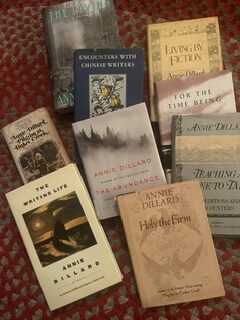
I’ve described how sometime in the mid-70s I picked up a paperback in a bookstore, probably the News Depot in Canton, Ohio, with an intriguing cover: Pilgrim, Dillard’s first book, is to the left in the photo. My father had died in 1971, and my dog had died very recently. Opening the book, I read the Heraclitus lines and started to cry. Pilgrim at Tinker Creek remains one of my favorite books. As my friend Barb (also a fan) recently wrote to me, “These affinities from our 20s can take root so deep inside us.”
I think I’ve read all of Dillard’s books. After seeing her New York Times obituary last Tuesday, I found an essay collection I’d never heard of, The Abundance, published in 2016, in the library card catalogue, but it contains only two new essays. Both definitely worth reading, I soon discovered.
Dillard wasn’t writing much of late, but painting instead. I read that she has donated proceeds from the sale of her paintings to Partners in Health and cited Ophelia Dahl and Paul Farmer of that organization in The Abundance’s acknowledgments. Another of my favorite books is Mountains Beyond Mountains, Tracy Kidder’s powerful 2003 portrait of Dr. Farmer and his efforts to bring medical care to all the world. I wonder if she learned about him through Kidder’s book.
I was an intense young woman in the mid-seventies, wrestling with grief. Dillard’s gnarly lyricism, her profound delving into the meaning of suffering–these appealed to my self-serious, self-conscious, readerly persona. But this week I’m aware that one of Annie Dillard’s most appealing features is her sense of humor. I always knew that, but I’m appreciating it more now.
One section of Pilgrim begins, “Fish gotta swim and bird gotta fly; insects, it seems, gotta do one horrible thing after another.” She proceeds to recount the horrors many insects species inflict on their victims. Her images and her language are full of wit, even when she’s conveying nature’s horrors or her inscrutable mystery.
Nature is a fan dancer born with a fan; you can wrestle her down, show her on the stage and grapple with her for the fan with all your might, but it will never quit her grip. She comes that way; the fan is attached.
The novelist Eudora Welty famously equivocated about Pilgrim at Tinker Creek in the New York Times Book Review. She gave the young writer credit for her ambition and beautiful language, writing, “A reader’s heart must go out to a young writer with a sense of wonder so fearless and unbridled.” But then, quoting a poetic passage about death, Welty is flummoxed: “I honestly do not know what she is talking about at such times.” Some years later, Welty visited Kent State, where I asked her about this review. Hesitantly, wrinkling her nose, she said, “I really didn’t like it very much.”
I rarely share that feeling that while reading Pilgrim but am sometimes bewildered by passages in other books. Holy the Firm is a tough one. For the Time Being is too, though it taught me everything I know about the theologian Teilhard de Chardin. (Not much has stuck after 25 years.) If I had to recommend a book besides Pilgrim, I’d choose Encounters with Chinese Writers (1984), which might seem surprising, but bear with me.
In 1982, Dillard traveled to China with a group of American writers as part of a cultural exchange and later helped host a delegation of Chinese writers visiting the U.S. She is a witty and sympathetic guide and observer, both for her Chinese cohorts and for us readers. There’s none of the convoluted prose that bothered Ms Welty. My favorite anecdote concerns the Beat poet Allen Ginsberg, who disgustedly dubbed a jingoistic film the group watched at Disneyland “Mickey-Mouse,” leaving the Chinese writer he’s talking to totally mystified. The film wasn’t about Mickey Mouse! he insists.
Here’s Annie Dillard’s straightforward, graceful ending to the introduction of this book.
These are only glimpses, not portraits; their subject is not China, and not even entirely Chinese writers, but a few vivid, equivocal moments in the days of some of earth’s people in the twentieth century. What interests me here, and elsewhere, is the possibility for a purified nonfiction narration–a kind of Chekhovian storytelling which might illuminate the actual world with a delicate light–coupled with humor in the American tradition and no comment.
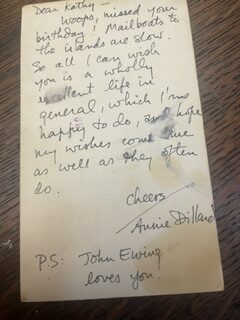
When I wrote the post I called “Fan Mail, Reversed” last year, I couldn’t find the birthday post card Annie Dillard sent me. Turns out it was tucked into Encounters with Chinese Writers and so has just been found. As I describe in the post, my then-boyfriend, now-husband wrote to her on Lummi Island off the coast of Washington, where she was then living. He told her how much I loved her and asked her to send me a birthday greeting. Here’s what she wrote.
Dear Kathy–Woops, missed your birthday! Mailboats to the islands are slow. So all I can wish you is a wholly excellent life in general, which I’m happy to do, and hope my wishes come true as well as they often do. Cheers, Annie Dillard
I think we heard Eudora Welty at my alma mater, Denison University — not Kent State.
Wonderful essay, Kathy! I also enjoyed seeing the photo of the postcard. John Ewing does love you (as do so many of us).