
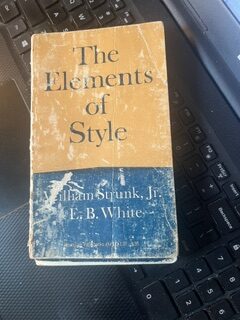
Vigorous writing is concise. A sentence should contain no unnecessary words, a paragraph no unnecessary sentences, for the same reason that a drawing should have no unnecessary lines and a machine no unnecessary parts. This requires not that the writer make all his sentences short, or that he avoid all detail and treat his subjects only in outline, but that he make every word tell. –The Elements of Style, William Strunk, Jr., and E. B. White, 1959
The New Yorker is well known for its careful editing, rigorous fact-checking, and long tradition of disciplined research and clear, pristine writing. E.B. White remains the New Yorker stylistic avatar, at least for someone my age. The pellucid prose of his own work, including essays and novels like Charlotte’s Web, reflects the precepts of his venerable writing handbook The Elements of Style. Many readers now consider the book outdated, but (again, at my age) it’s hard to let go of principles learned in Mildred Morgan’s 10th grade English class. I strive for an E.B. White level of succinctness and clarity in my writing (often missing the mark) and admire these qualities in other writers.
Hence, this rant about Richard Brody, who currently shares New Yorker film-critic duties with Justin Chang. Film buffs often assail Brody for his contrarian opinions; he tends to champion esoteric, arty movies and critique the hits beloved by the crowd. I have no beef with him on that count.
My beef is with his convoluted, often incomprehensible phraseology. I frequently read his sentences aloud to my husband, wailing, “What is he talking about? Why does the New Yorker let him get away with this stuff?” My husband conjectures that Brody “has something” on editor David Remnick.
For example. I share Brody’s admiration for Nathan Fielder and Lance Oppenheim’s new documentary about Elizabeth Holmes, You Can See Everything. It’s not his opinion I deplore. It’s his sentences. In a passage about the visual element of the film, Brody writes, “Multiple cameras set on tripods yield intently composed images that contrast with the spontaneity of the events they capture. (A downside is the movie’s snippety editing, which precludes the tension of continuous unfoldings.)”
Snippety editing precludes tension. If you say so. And continuous unfoldings? Does he mean that quick cuts disrupt the graceful rhythm that has gone before?
Who can say?
At the review’s end, Brody compares the film to Robert Bresson’s classic Pickpocket (1959). No spoilers here: Brody does not bother with mundanities like what happens in the movie. Instead, he writes,
“Bresson projected Christian exaltation. ‘You Can See Everything’ achieves something even more surprising: a rational sublimity, a twist of conceptual beauty, like an equation that proves the existence of love.”
Those words sound pretty. Brody’s going for something sublime himself, I guess. But what the heck. What’s an equation that proves the existence of love? What’s a twist of conceptual beauty? What’s rational sublimity?
Beats me.
Let me know if you disagree.
I’m reading Henry James’s Portrait of a Lady. He forgot to omit words. Needless is in the eye of the beholder. But James was creating art.
It’s another thing entirely different for a critic writing for the public to practice obscurity just for the heck of it. And where is his editor?
I certainly don’t disagree. I have always tried to keep in mind something S.I. Hayakawa said when he was just a linguist and not Ronald Reagan’ s Republican senator from California.
“If you want to know if a word means anything, cover your mouth and point.”
Maybe Brody can point to rational sublimity, but I doubt it.
Theology is full of those kinds of words and phrases.