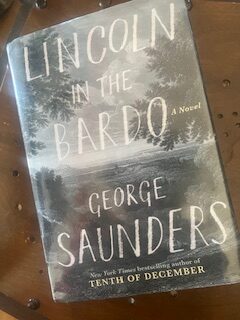
Almost ten years after my first attempt, today I finished George Saunders’s 2017 novel Lincoln in the Bardo, just in time for Lincoln’s 217th birthday. This was my third run at the book, and this time I finally made it through.
I have a distorted memory of my first two efforts, retaining an impression of a lot of bathroom humor and potty jokes, which, even though I’m not prudish (I don’t think), were too sophomoric for me. Turns out I mostly made that up. A single poop appears on page 6. About twenty pages later, there’s a “swollen member,” but, really, such references are scattered and pretty innocuous. It’s a mystery how I so drastically misread the book.
The novel begins with speeches by seemingly random people who inhabit a weird unfamiliar place; an acquaintance described it to me as “almost science fiction.” It reads like a play, a lot of it comic, mostly dialogue and short prose passages, with lots of white space on the page. It goes fast, then, once you get into it and figure out what’s going on. Googling after I finished, I found this brief, genial guide provided by Saunders himself. Check it out if you find the book’s experimental format daunting.
Coincidentally, just as I began Lincoln earlier this week, I received an email from a stranger, a friend of a friend, who loves George Saunders so much that she’s looking for a like-minded fan to communicate with. Our mutual friend thought I might be such a person. I loved Saunders’s short story collection Tenth of December (2013) and his 2021 essay collection A Swim in a Pond in the Rain: In Which Four Russians Give a Master Class on Writing, Reading, and Life. Like everybody else, I admire his inspiring Syracuse commencement speech from 2013. I probably haven’t read as much Saunders as my prospective correspondent (I haven’t heard back from her since I responded), but I’m a fan.
Saunders’s down-to-earth goodness makes him an ideal conduit to convey Lincoln’s humanity and his profound grief over the loss of his son Willie to typhoid fever in 1862. What do you do with grief? How do you live with loss? Saunders’s imagining of Lincoln’s thoughts reflects his own generosity.
“His mind was freshly inclined toward sorrow, toward the fact that the world was full of sorrow, that everyone labored under some burden of sorrow; that all were suffering; that whatever way one took in this world, one must try to remember that all were suffering (none content; all wronged, neglected, overlooked, misunderstood), and therefore one must do what one could to lighten the load of those with whom one came into contact; that his current state of sorrow was not uniquely his, not at all, but, rather, its like had been felt, would yet be felt, by scores of others, in all times, in every time, and must not be prolonged or exaggerated, because, in this state, he could be of no help to anyone and, given that his position in the world situated him to be either of great help or great harm, it would not do to stay low, if he could help it.”
Fran–A Swim in the Pond in the Rain is a wonderful book, as are GS’s short stories. It includes the stories that he writes about, so you get to read all this great Russian literature as well as his very readable and often funny insights.
Sarah–That’s a great way of putting it.
Roger–I thought of you as I read L in the B. So glad you’ve read it.
I love the way you love books, Kathy. I think Saunders writes books that meet us when we’re ready to read them and not before. Particularly this one.
Lincoln turned empathy into a strength.
Thanks, Kathy. LITB is the only one of Saunders’ works I’ve read and I liked it a lot (because of its strangeness??). Loss and grief and continuing on anyway. Thanks, George.