Roxie and Verna

This whole dog thing started because of a story Verna used to tell over and over again. It was a very sad story I can’t bear to repeat, but it had to do with leaving behind her much-loved dog when she moved to Cleveland from Pennsylvania decades ago. I used to drive Verna to church, and whenever she saw someone walking a dog, she would repeat that story, much to my dismay, and end by saying she loved dogs and wished she could have a dog in her apartment. Even when she became unsteady on her feet, Verna would insist she’d like to have a black lab, her favorite breed. A lab could have knocked Verna over just by breathing on her, but that was the kind of dog she hankered for.

If you don’t much care for dogs, you should probably stop reading now. Sometimes when I start on this track, even talking to people who loved Verna, their eyes glaze over, and I realize they’re feeling the disengagement of non-dog-lovers when people like me start going on about dogs. Not everyone loves dogs, so feel free to just move along and read something else now. No hard feelings.

Verna and Portia

Verna and Portia

Verna died a couple of weeks ago at the age of 95, and her funeral was today. I’ve been thinking about what to say about her, if anything, and finally felt inspired by our dog connection. Because Verna loved dogs and couldn’t have one, a few years ago I asked my friend Joanne to bring Portia, her lovely golden retriever in possession of an actual therapy dog certificate, to visit Verna with me. Portia is calm and sweet, and Verna really enjoyed meeting her and petting her. Then, by a convoluted set of circumstances, I acquired our little dog Roxie and tried her out with Verna. At first, Roxie was antsy, exploring Verna’s rooms, and Verna would insist that Roxie must have to pee. But she didn’t. She just had to get acclimated. After awhile Roxie would calm down and sit on Verna’s lap, and Verna would pet her. Even though Roxie is about one-tenth the size of Verna’s preferred dog variety, they got along. Verna called Roxie cute and enjoyed getting her face licked. Roxie accommodated herself to Verna’s skinny lap and sat with her for as long as we wanted her to.

About ten months ago, Verna’s health problems worsened. She ended up in a nursing home about five minutes from my house. I soon ascertained that the nice attendants welcomed visits from dogs, and I began taking Roxie along with me. Some of the other residents clearly didn’t like dogs or were afraid even of a seven-pound Maltese, but others were excited to see Roxie come in. Verna always enjoyed it, and Roxie made things easier for me, frankly, because as Verna’s memory gradually failed, Roxie gave us something to talk about. Verna couldn’t tell stories anymore or recall her recent visitors. Because Verna’s mind was entirely in the present, Roxie was the perfect visitor, because Roxie the dog lives in the present, too.

entreating Roxie

Roxie

It moved me not only to see how much Verna enjoyed Roxie, but how earnestly Roxie attempted to do the right thing for all of us. It was hard to balance on Verna’s sloping legs in a wheelchair, and Roxie would keep her eyes on my face, checking to make sure she was supposed to stay there. Eventually, she’d settle in, lie down, and accept Verna’s affectionate petting. She’d greet the other residents joyfully, even when they were loud and clumsy.

Like pretty much everything in life, these memories are a mixed blessing now that Verna’s gone. I’m glad she and Roxie got to know each other, I’m grateful the nursing home was welcoming, and I’m happy I visited as much as I did, although I could have done more. Now, though, when I look at Roxie’s entreating face, I don’t just see my funny, much-loved dog. I see her perched on Verna’s lap, and she reminds me of my loss.

Posted in Uncategorized | 23 Comments

Required Reading

Barb's listI haven’t read many books recently because I’ve been reading Bleak House, Charles Dickens’s 800-page novel of 1853. It was supposed to be my winter break project, but I started it late, after New Years, and it’s seeped into the second semester, which started two weeks ago. I.m surprised it’s taking me this long, but I think playing on my phone, doing schoolwork, and socializing have generally cut into my reading time. Also, I’m more confused by the abundant sub-plots than I remember being the first time I read it, but maybe my mind was fresher and clearer back in my twenties. You think?

Today, coincidentally, I was cleaning out my jewelry box where I keep the original, 1976 assignment to read Dickens’s novel. This memento, a large index card, contains fourteen typed titles and some instructions written in mock grad school mode. My friend Barb, who prepared the list for me, says, “Feel free to consult any critical works you deem worthwhile or necessary and, of course, I am available during office hours for consultation.”

This was our deal: leaving grad school at Kent State University with a reading list of ten books (note how Barb cheated) for the other to read. Barb had already broadened my horizons considerably by making me read C.S. Lewis’s The Chronicles of Narnia. And she was always harping on Tolkien. She used to leave cryptic notes in my mailbox at Satterfield Hall with dire warnings such as: “Beware, Thorin and all, the day of the Orcs attack under the Misty Mountain!” That’s not right, of course. I enjoy Tolkien but can’t remember details like the true fans. At the time, these notes were utterly mystifying, but I soon learned that Barb derived them from her Lord of the Rings calendar. I felt browbeaten into reading the trilogy but then appreciated it and have reread it several times, or possibly two, since then.

So Bleak House is on Barb’s list, and I read it and loved it back then, after we had gone our separate ways, but never reread it till now. It’s number thirteen on the list. In her pedantic way, Barb instructed me in what order to proceed. I was to start with Colin Wilson’s The Outsider, move on to Cyrano de Bergerac, Nabokov’s Pale Fire, and Ayn Rand’s Atlas Shrugged. I’ll include the remaining titles below.

Maybe you’re wondering what books I told Barb to read. Unfortunately, I can’t remember, especially since we were including only books the other person hadn’t yet read. I can surmise I included Annie Dillard’s Pilgrim at Tinker Creek and James Agee’s A Death in the Family and Let Us Now Praise Famous Men. I’m pretty sure she read my recommendations, and I know I eventually completed her entire list. I enjoyed and admired them all. Barb’s taste ran more to Brit lit than mine, and she challenged and deepened my taste. At the end of Charlotte’s Web, E. B. White says, “It is not often that someone comes along who is a true friend and a good writer. Charlotte was both.” I’d add a third criterion, “a good reader,” and declare that Barb is all three.

The rest of the list:

Lucky Jim by Kingsley Amis

To the Lighthouse by Virginia Woolf

Brideshead Revisited by Evelyn Waugh

All Hallow’s Eve by Charles Williams

Under the Net by Iris Murdoch

Anne of Green Gables by Lucy Maud Montgomery

The Marble Faun by Nathaniel Hawthorned

Tristram Shandy by Laurence Sterne

Posted in Books | Tagged , , , , , , , , , , , , | 10 Comments

The Last Batch

Here you see my last seven Christmas cookies, who have been waiting  frigidly since December 23, 2015. Their sister cookies went into the oven and came out again on that Wednesday afternoon. When these were arrayed on the baking sheet, my oven door stuck shut.

Fortunately, no cookies were trapped inside the oven. Also fortunately, my two pumpkin pies were already baked. Unfortunately, we expected sixteen guests the next day, some of whom expected to eat home-baked turkey. The turkey was defrosting glacially in the refrigerator, but how was it going to get cooked?

I explained the problem to my husband and son, who proceeded to do exactly what I had been doing. They pulled on the oven door, which opened a few inches on the right but remained immovable on the left. In my secret heart, I knew that the door had been catching on that left side for months, needing an extra little oomph to open. I had been ignoring that little oomph.

During the next few hours of negotiation and planning (even into the next day after the guests arrived), somebody or other would now and then stop by the stove and give the door a yank, hoping that he or she would be the one to pull it open. No go.

We called Sears. We called appliance companies. Repair persons offered us appointments in January. What to do? Call the family? Change the date? Throw ourselves on the mercy of friends or neighbors and steal their valuable holiday-oven space? Then we thought of the HoneyBaked  option. HoneyBaked Ham was open. HoneyBaked Ham still had inventory. My husband drove to their store (getting lost because of its new location), waited in a long line, and like an ancient hunter-gatherer brought home two kinds of meat, turkey and ham. Improving on the ancient hunter-gatherer, he brought meats home thoroughly cooked.

I already had another meat option underway. Because my brother-in-law Ed likes two kinds of meat at dinner, I generally prepare something besides turkey. In recent years, it’s been a pork roast in the Crock Pot, tossed in with a bag of sauerkraut and left alone for twelve to fourteen hours. That means this Christmas we exceeded Ed’s fondest dreams: we  served three meats. And this is from a vegetarian cook.

The stove saga stretches on in an even less interesting way. Suffice it to say that the repairman fixed the oven door on Wednesday, January 13. He replaced the left door hinge.

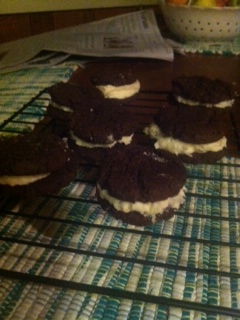
Today I defrosted the remaining cookie batter, opened and closed the oven successfully, and now have seven homemade Oreo cookies. The recipe’s at the Smitten Kitchen website. The cookies are fussy but fun to make, and they taste very good, even after being frozen for almost a month.

http://smittenkitchen.com/blog/2007/05/my-kingdom-for-a-glass-of-milk/


Posted in Uncategorized | Tagged | 7 Comments

KSU and the English Language

In his 1950 essay “Politics and the English Language,” George Orwell wrote that the English language was in a bad way, hastening to clarify that he wasn’t talking about bad grammar. Instead, he was talking about verbosity, empty metaphors, and, ultimately, misleading political language. If he hoped his prescient essay would clean things up, he would be sadly disappointed. He merely eloquently predicted the far worse state we’re in sixty-five years later.

I won’t go into the profound issues Orwell raises about politicians’ obfuscations. My narrow focus carps on bad writing. I plan to pick on my alma mater, the esteemed bastion of higher education, Kent State University.

The latest issue of the alumni magazine includes an article about the University’s new strategic plan (those two words should send a chill up your spine) entitled “Path to the Future,” and it doesn’t get any better after the title. The caption underneath reads, “Kent State University is developing a strategic roadmap that will enable it to move boldly in new directions and distinguish itself not only in Northeast Ohio but around the world.”

 I hate “strategic roadmap” even more than “strategic plan.” And as the article goes on to explain, we’re going to be doing a whole bunch of things “boldly.”

President Beverly Warren is quoted as saying, “We must be courageous and creative as we bring to life a shared vision for our future—a vision that honors our past as it defines a new era of influence and involvement, and a vision that helps us to boldly and clearly share our remarkable story with the world.”

Our vision, the article says, is “to be a community of change agents whose collective commitment to learning sparks epic thinking, meaningful voice and invaluable outcomes to better our society.”

Our commitment to learning sparks “meaningful voice.” English, anyone?

Our “core values” consist of “life-changing educational experiences for students,” a collaborative community, “a living-learning environment that creates a genuine sense of place,” and so on.

Here’s my question. Do these words have any meaning whatsoever? The place being Northeast Ohio; Kent, Ohio; Taylor Hall? What is a “genuine sense of place,” as opposed to a mere sense of place?

I could keep on quoting, but you get the idea. It’s as though committees in all our institutions—schools, businesses, hospitals, churches—dump out a kit full of pat phrases and shuffle them around on a table and eventually make grammatical, but meaningless, sentences out of them.

Orwell put it better: “Prose consists less and less of words chosen for the sake of their meaning, and more and more of phrases tacked together like the sections of a prefabricated hen-house . . .  It consists of gumming together long strips of words which have already been set in order by someone else, and making the results presentable by sheer humbug. The attraction of this way of writing is that it is easy.”

Another advantage is that we never have to achieve anything. We can always say we have established a collaborative community and positive engagement and active inquiry. We have sparked meaningful voice! Who’s going to prove we haven’t?

Posted in Uncategorized | Tagged , , | 3 Comments

Update

my coat


It being October, you’re probably wondering whatever happened with my four summer tasks. Here they were, as I described them on May 6th: replacing the lining in my winter coat, buying a new hair-catching drain thingy for our upstairs sink, reupholstering a disreputable living room chair, and getting rid of a large pipe in our backyard.


Hair catching thingy did in fact fit and has been catching hair in the intervening months.


Reupholstering has not yet taken place, but we have a shop and a fabric and money deposited. The shop can’t fix the chair for another month or so.


I left the pipe on our tree lawn (as we call it here in NE Ohio), and a gleaner picked it up within an hour or two.


Alas, the coat. No one will provide an estimate under $150. I’m thinking I might rip out the tattered lining and do without, or clumsily stitch in some lining myself. I haven’t given up. I don’t give up, which means, in other words, that I can procrastinate endlessly.


Posted in Uncategorized | 1 Comment

Afflicting the Comfortable


Dorothy Day

Pope Francis’s shout-out to Dorothy Day in his speech before Congress yesterday gives me an excuse to share my favorite Dorothy Day story.

Day, of course, was the co-founder of the Catholic Worker movement in the 1930s, which still publishes its newspaper (of the same name) and maintains over 200 houses of hospitality in cities across the country. The movement espouses non-violence and a “personalist” Christianity centered on the works of mercy—feeding, clothing, and sheltering people who need help.

My story comes from the writer and psychiatrist Robert Coles. (Here’s to you, Jamie Kaplan!) In his book Dorothy Day: A Radical Devotion (at least I think that’s where I read this), he describes coming to a Catholic Worker house as a young medical student, hoping to volunteer. He found Day sitting at the kitchen table talking at length with a street person staying there. The person was poorly dressed, and maybe drunk and mentally ill. (I haven’t reread the story and probably have the details wrong.) Coles describes waiting patiently while Day devoted all her attention to the person in front of her.

At last she turned to Coles and asked mildly, “Which one of us were you waiting to talk to?”

I can see myself in this story up to a certain point. I could be Robert Coles volunteering. I could even be, like Dorothy Day, sitting with a homeless, mentally ill person listening to what he or she has to say. It’s that final turn that startles. Paying attention to that homeless person, I would be self-consciously aware I was doing a nice thing. I would be aware there was some other person—subliminally aware it was a “person like me”–waiting to talk, no doubt, to me. Day’s radical response takes us to the roots of Christianity and her profound commitment to them. For Dorothy Day, as for Jesus, the three people in that story are all exactly equivalent and deserving of equal attention and respect.

I love this story because it shows me a way beyond conventional goodness, beyond even extraordinary kindness. It reminds me of a story about Dr. Paul Farmer in Tracy Kidder’s Mountains Beyond Mountains. (Thanks to my friend Michael Whitely for the reminder.) At a Boston hospital, he describes Farmer visiting a “non-compliant” AIDS patient, called Joe. On his way through the hospital, Farmer pauses to chat with aides, nurses, and janitors. He asks them about their blood pressure or their mother’s diabetes. When he arrives in Joe’s room, he sits on the bed and strokes Joe’s shoulder as they talk.

Finally, Joe has said his piece, and Farmer has shared some advice. Kidder senses the visit is coming to an end, because, in the normal course of things, the specialist “makes some small talk with the patient, then departs.” But Farmer, he writes, “was still sitting on Joe’s bed, and he seemed to like it there. They talked on and on.” Joe gradually opens up.

Farmer asks Joe “a heavy question.” What would Joe really like? What would work for him and prevent his continually bouncing back and forth between the hospital and the street? Joe says he’d like a home where he could stay out of trouble and have a beer now and then. Farmer listens carefully. “He leaned over Joe,” Kidder writes, “gazing down at him, pale blue eyes behind little round lenses.” He acknowledges that Joe’s plan makes a lot of sense.

A few days later, this message appeared on the hospital’s social work department’s bulletin board:


                                                JOE

OUT                                                                                        IN

cold                                                                                         warm

their drugs                                                                             our drugs

½ gal. vodka                                                                          6 pack Bud


A nice doctor would visit Joe. An extraordinarily attentive doctor would spend some time and listen closely and pat him on the shoulder. But it’s all the extra stuff that gets to me and humbles me. It’s the sitting on the bed, the eye contact, the joking. It’s the challenging, radical, funny note on the bulletin board.

It’s not that we don’t have “time” to do these things. It’s that we—that is, I—don’t even think of them. I give myself a lot of credit just for basic decency and politeness. The Pope, in his personal attentiveness, and Dorothy Day and Paul Farmer, like my friend Father Dan Begin, shake up my complacency.


Posted in Books | 7 Comments

Ice Cream Adventure with John

John went in to East Coast Custard by himself while I sat outside with our dog. He came out with a milkshake. “I got something different,” he said proudly. I thought he was joking, assuming he ordered what he always orders, a jamocha shake. “No, it’s not jamocha,” he said. “It’s raspberry truffle!”

His cup had not a hint of pink, so I didn’t believe him.

“No, it’s not raspberry,” he admitted. “But it’s really a vanilla malt!” He said this as though incredulous at his own daring.

As he began sipping, he pulled something from the bottom with his straw. “What’s that?” he said. “A pecan? Why would there be a pecan in a vanilla malt?”

There wouldn’t, I said. “Then why is it in there?” he said. I said maybe it got in by mistake.

Soon he found another pecan. “What if this is really butter pecan?” he said. “Why would they do that?”

“Can’t you tell?” I asked. “Does it taste like butter pecan or a vanilla malt?”

He took another sip and thought for a second. “I can’t tell,” he said.

I suggested he go back in the shop and say there had been a mistake.

He responded that the young clerk wasn’t very friendly. “Maybe she’s trying to burn her bridges with every customer and get fired,” he surmised.

Or maybe someone made a mistake, I said, or you picked up the wrong order.

John kept sipping, every now and then making a face. We drove home, and when we got out of the car, he showed me the smattering of chopped pecans at the bottom of the cup, as though to prove his point.

“You didn’t have any trouble finishing the whole thing,” I said.

“It was hard,” he said. “I had to force it down.” Then he offered me the cup. “You want these pecans?”

I declined.

 “They have a new motto,” John said. “‘Don’t have it your way. Have it our way.’”


Posted in Uncategorized | Tagged , , | 8 Comments

Changing My Status, Except Not Really

A while back, I noticed I had never listed a relationship status for myself on Facebook. After decades of marriage, I felt confident in listing my status as “married.” I first clicked “Edit Profile” and then “Family and Relationships,” and then edited my relationship status, remedying my previous oversight.

Possibly due to my own aged-person ineptitude, or possibly due to other people’s misunderstanding, I’ve encountered questions and concerns ever since.  Suddenly, anniversary best wishes were pouring in, followed by inundations of congratulations. Facebook connects you to people you don’t see often and whom you don’t even know well. When on occasion I run into some of these, they remember to ask, commiserate, and/or congratulate.

“I don’t know what happened, Kathy,” such a person recently told me, gravely placing her hand on my forearm. “But, whatever it was, I’m happy for you, and congratulations.”

Facebook may think I changed my status, and I may have mistakenly made it seem like I changed my status, but I didn’t really change my status. This is just to clarify, today, on my 37th wedding anniversary, my actual relationship status is unlikely to change until one of us dies or kills the other one.

Posted in Uncategorized | 3 Comments

Missing Dave

In all the hoopla over David Letterman’s retirement, we read over and over about the heart surgery, the post-9/11 show, and the sex scandal. Everyone mentions favorite guests Julia Roberts, Regis Philbin, Bill Murray, and Cleveland’s own Harvey Pekar. Frequently cited are watermelons tossed from the roof of the Ed Sullivan Theater, Stupid Pet Tricks, Top Ten Lists, and Dave, wearing an Alka-Seltzer suit, immersed in a giant water tank.

All noteworthy, to be sure, though I never cared much for tossing things off the roof. But it’s all been said, over and over. I don’t want to repeat the usual tropes, but I have an urge to express my affection and respect for David Letterman, who, in all his incarnations, is my favorite TV experience. Because we don’t get cable, I’m missing out on the current Golden Age of TV—no Sopranos, no Wire, no Breaking Bad. Mystifying my friends, I don’t care a whit about “Downton Abbey.” I have binge-watched only one show: “In Therapy” with Gabriel Byrne. Instead, I have enjoyed many foolish comedies: “Cheers,” “Everybody Loves Raymond,” “The Office,” and, currently, “Modern Family.”

My Dave fandom, though, is deeper and wider. I actually saw a few episodes of his 1980 morning show and liked them. I used to enjoy his stand-up appearances on “The Tonight Show” and  would even defend his hosting of the Oscars. I watched Dave almost every night for almost thirty years. My husband, cinephile and movie exhibitor, often gets home late, and we watched Dave together. Otherwise, my husband doesn’t watch TV, so this was a rare bonding, extra-cinematic, entertainment experience. We both love Dave.

So here I want to share two things that haven’t appeared widely. One is an insight I read somewhere online. The other is a very slight, beloved quirk of Dave, again, unmentioned in most of the written hoopla.

I can’t locate the column right now, but one writer made this cogent observation. Dave made you feel like you were in on the joke, making an inclusive group of his audience. Maybe this is what put some people off, because, watching only occasionally, they’d feel excluded instead of included. But if you watched regularly, you understood some things. Why did Dave run across the stage every night when his name was announced? Because he did it the first night back after his heart surgery to show his robust health. Why did he repeat jokes so often? Because the repetition itself was funny. He had certain favorites: George W. Bush walking into a door, a deer rearing up and pummeling a hunter, Dave and Paul Shaffer shouting together, “I wouldn’t give his problems to a monkey on a rock!” These were funny because they were so silly and because you were sharing a joke with Dave. Dave liked “Will it Float?” and “Is This Anything?” and you were inclined, if you liked Dave, to go along with these nonsensical bits.

Dave was known for being private and press-avoidant to the point of surliness. However, you could watch Dave regularly and feel that you almost knew him, although you’d never crack the mystery of his complicated self. “He’s the most three-dimensional talk-show host ever — hell, he’s probably the most vividly revealed person who’s ever been on television,” wrote Entertainment Weekly’s Ken Tucker. “The sheer number of hours, combined with a compulsive honesty that trumps reticence, means that he has exposed more moods and aspects of his personality than any human in front of a TV camera.” Jay Leno, in contrast, reputedly so personable and “nice,” is a complete blank to me. He likes cars and has a solid marriage to a good woman, but otherwise, I don’t know a thing about him. Jay told jokes, whereas Dave was himself part of the joke. Which you prefer is a matter of taste, I suppose.

Finally, here’s one of my favorite Letterman quirks. I’m sure it’s been written about somewhere, but I’ve never seen it. Dave habitually put a “the” in front of things where “the” didn’t belong. On rare occasions, a guest would smile and repeat Dave’s verbiage, noting the idiosyncrasy, but mostly it went unremarked.

“Breaking Bad,” cited above, would be instead “The Breaking Bad,” or possibly  “the Breaking Bad program.” Julia Roberts starred in, for example, “The Steel Magnolias” and “The Pretty Woman,” and Bill Murray in “The Caddy Shack.”

I don’t know why Dave did this, and I can’t explain why it’s amusing. It set Dave apart, just a little bit. Like the Sneezing Monkey, Dave found it funny for his own reasons, and I for one am already missing it.

Posted in Uncategorized | Tagged , , | Leave a comment

A Ewing Kind of Day

After my Mother’s Day brunch at Corky and Lenny’s this morning, my husband John asked me what else I wanted to do today. I suggested that he and our son and I take a little walk in a park with our dog. He asked which park I would like to visit.

“Euclid Creek or Acacia,” I said. These are two large Metroparks near our house.

“We can’t go anywhere where there are other dogs,” he said. “There’s that dog flu going around.”

I had no response to that.

“Or coyotes,” he added. Coyotes are rumored to have been spotted at Acacia. “Maybe we could go to that park by the Recreation Pavilion.”

“Forest Hills Park,” my son and I said together. “They don’t allow dogs there.”

“They do let dogs there,” he said. “We could go to Cain Park.”

“OK,” I said. “I think maybe they do let dogs at Cain Park. I haven’t been there for a long time. Let’s go there.”

“But there’s nothing to see at Cain Park,” John said. What John likes to see at any park is water. There’s no water at Cain Park.

“Why did you suggest Cain Park then?” I asked.

“I didn’t say Cain Park. I said the park by the Recreation Pavilion.”

My son and I looked at each other. We told John he had suggested Cain Park. He denied it.  Apparently he was mixing the parks up. We dropped it.

Then John said, “We could go up to the lake.” That would fulfill his water-viewing needs, so I said okay. On the way to Lakefront Lodge Park in Willowick, John was wondering out loud about Biagio’s, a doughnut shop somewhere nearby that had recently won Northeast Ohio’s Best Donuts People’s Choice Award. John is a doughnut connoisseur.

At the park, it was overcast and breezy but beautiful. I was wearing a skirt and sandals, not dressed for climbing down the steep slope to the lake and walking on the rocks. I sat on a bench looking out at slate-blue Lake Erie fading into the grayish horizon. The dog sat on my lap. My son returned before John and asked, “What are the chances we’re going to stop for custard on the way home?” I imagined the chances were pretty good.

On the way out of the parking lot, John turned left, and I knew he was headed to CP’s Cooler, an ice-cream shop on Vine Street. We pulled in and took turns watching the dog and going inside to order our ice cream. We sat chatting, and then, as we were finishing our ice cream, John suddenly jumped up, saying, “I’ll go inside and ask them.” My son and I wondered if he was going to ask them why New York City has an ordinance forbidding the exhibition of nitrate film, which is what we had been talking about.

It turned out John wanted to know where the doughnut shop Biagio’s was. Right down the street, as it turned out!  So we headed down Vine Street and pulled into Biagio’s, where John got a bag of doughnuts.

We took the long way home, because John wanted to show us the Ford dealership in Wickliffe where he had recently gotten his car repaired. On the way, he pointed out the route he had walked while waiting for his car to be finished. “And that’s where I got a tattoo,” he said, pointing to the Atom Bomb Tattoo parlor. He was kidding.

When we got home, I took a nap, and then my daughter called. All in all, it was a very nice Mother’s Day.

Posted in Uncategorized | Tagged , , , , , , , , , , , | Leave a comment